


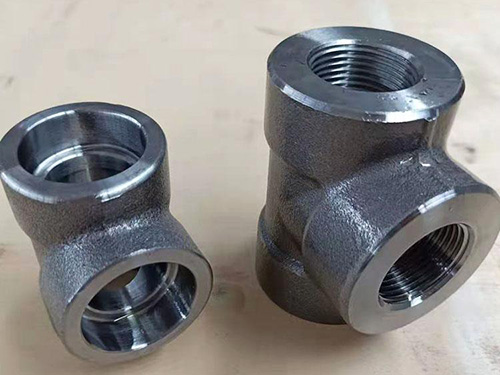
Socket
Plug in fittings, mainly divided into high-pressure pipeline connection fittings, are formed by molding and forging blanks from round steel or steel ingots, and then processed by lathe machines.
Forged socket is a component made by forging Forging is the process of producing parts through impact force.
The processing method of using forging machinery to apply pressure to metal billets, causing them to undergo plastic deformation, in order to obtain forgings with determined mechanical properties, shape, and size. By continuously pounding the pipe fittings, the existing segregation, looseness, porosity, slag inclusion, etc. inside the steel ingot are compacted and welded, making its structure compact and improving the plasticity and mechanical properties of the metal. Forged pipe fittings mainly include forged flanges, forged reducers, forged tees, etc.
The main materials for forged socket fittings include q235, q345, 16mn, 20 #, 35 #, 45 #, 40Cr, 12Cr1MoV, 30CrMo, 15CrMo, 20G, etc. Corresponding to forged socket fittings is cast pipe fittings, which have lower mechanical properties than forgings of the same material. Cast pipe fittings melt metal into a liquid that meets certain requirements and pour it into a mold. After cooling, solidification, and cleaning treatment, they are deeply processed into castings (parts or blanks) with predetermined shapes, sizes, and properties.
Forged bearing plugs are mainly suitable for departments and industries such as petrochemicals, pharmaceuticals and healthcare, electricity, aerospace, high-quality products, fire protection, metallurgy, shipbuilding, gas, nuclear power, and environmental protection that require high pressure and fine size.
Phone:+86-0317-6811238
Phone:+86-15031897777(Ethan Liu)
wechat:15031897777
E-mail:info@wrpipefitting.com
Address:Muzhuang Industrial Zone, Mengcun Hui Autonomous County Cangzhou City,Hebei Provice, China

Open mobile station
Copyright © 2022-2023 http://www.hbwanrui.com. All Rights Reserved Hebei Wanrui pipe fittings Co., Ltd 冀ICP备2022018226号-1